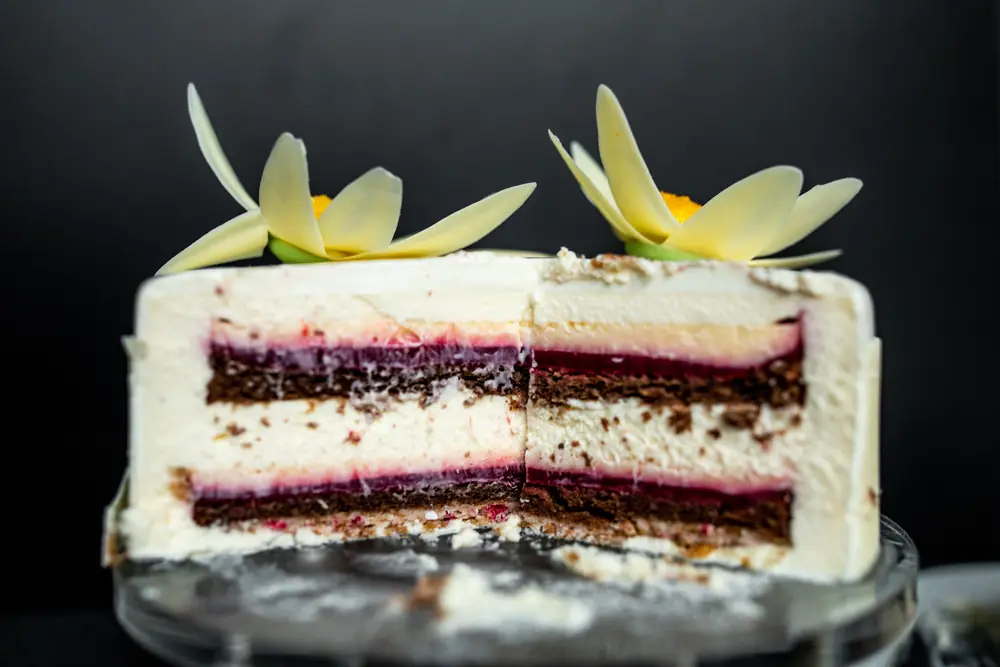
Fruit confit is one of the preparations I use when I want fruit to remain vivid and recognisable but need more control than a loose compote gives me. In modern pastry, the name is used quite broadly, so I care less about defending the label and more about making the fruit layer taste fresh, cut cleanly and behave correctly inside the finished dessert.
My raspberry confit formula
This is a soft, pastry-style raspberry confit intended for inserts, layers and tart applications. I specify Pectin NH deliberately: pectins are not interchangeable, and changing the pectin can change both the process and the final texture.
- 375 g raspberry purée
- 55 g sugar
- 55 g powdered glucose
- 6 g Pectin NH
- 4 g lemon juice
How I make raspberry confit
Mix the sugar, powdered glucose and Pectin NH thoroughly while they are dry. Warm 125 g of the raspberry purée to 40°C / 105°F, then whisk in the dry mixture gradually so the pectin disperses without forming lumps.
Bring the mixture to a full boil while stirring. Remove it from the heat, add the remaining 250 g cold raspberry purée and the lemon juice, and blend or whisk until completely homogeneous. Transfer to a clean container, cover the surface and chill until set before using.
For an entremets insert, I usually portion the confit into the required mould or ring and freeze it as part of the assembly process. For a tart or plated dessert, I can use the same preparation chilled, adjusting the amount and presentation to the dessert rather than forcing it into a thick layer.
What is fruit confit in modern pastry?
In contemporary pastry, fruit confit usually means a concentrated fruit preparation with a deliberately controlled, spoonable or sliceable texture. Some versions contain pieces; others are made from purée. Many professional preparations called confit are technically soft pectin gels.
There is no single universal confit formula. Raspberry, mango, passion fruit, pear and citrus differ in acidity, fibre, natural pectin and water content. The formula should follow the fruit and the job the layer has to do.
Fruit confit versus compote
Compote is generally softer and may contain obvious cooked fruit pieces. It can rely largely on cooking, sugar and the fruit's own solids rather than on a precisely formulated gel network.
When I make a confit for an entremets or celebration cake, I normally need more control. The layer may need to cut cleanly, remain where I place it and survive freezing and thawing without becoming rubbery or releasing excessive water.
Fruit confit versus fruit gel and jam
There is no strict technical border between a pastry confit and a fruit gel. A pectin-set preparation may be called either depending on the chef, supplier and application. I use the texture and function as the more useful distinction.
Jam has a different purpose. It is designed primarily as a preserve or spread and often uses substantially more sugar and a different endpoint. A cake insert does not need to imitate jam simply because both preparations contain fruit, sugar and pectin.
Why I specify Pectin NH
Pectin NH is particularly useful for many pastry fruit preparations because it can create a tender, thermoreversible gel suitable for glazing, inserts and fruit layers. That does not mean every product labelled pectin behaves the same way.
High-methoxyl, low-methoxyl and amidated pectins gel under different conditions, and commercial blends can have their own requirements. I therefore follow the technical behaviour of the exact pectin in the formula instead of transferring one percentage blindly from another recipe.
Why mix pectin with sugar first?
Adding pectin directly to warm fruit is an easy way to create stubborn lumps. Dispersing it thoroughly through the sugar and glucose first separates the particles so they hydrate more evenly when the mixture reaches the warm purée.
I add this mixture at about 40°C / 105°F: warm enough to begin proper dispersion, but still comfortable to whisk in gradually before the mixture reaches the boil.
Why sugar, glucose and acidity all matter
Sugar is not present only for sweetness. It changes soluble solids and water availability and therefore influences the way the fruit preparation sets. Powdered glucose lets me shape sweetness and solids differently from using sucrose alone.
Acidity affects flavour and can also affect pectin behaviour. Lemon juice in this raspberry formula sharpens the fruit and forms part of the balance of the complete system. If I substantially change the sugar, acid, fruit or pectin, I treat that as reformulation rather than assuming the original texture will remain unchanged.
How firm should a fruit confit be?
For a mousse-cake insert, I want enough structure for a clean slice but still a juicy sensation when the dessert is eaten cold. For a tart, I may want the same fruit flavour in a softer, more spoonable layer. For plated pastry, an even looser texture can be appropriate.
I avoid the common mistake of equating more gel with more professionalism. If the fruit layer eats like a separate block of jelly, it is usually too firm for the kind of entremets and cakes I prefer.
Can fruit confit be frozen?
A confit intended for entremets should be judged after the same freeze-thaw cycle it will experience in production. Pectin NH is useful for this kind of pastry work, but the complete formula still matters.
I do not evaluate a new fruit preparation only while it is freshly cooked. I chill it, freeze it when the application requires freezing, thaw it, then check whether it still cuts cleanly and whether any water has separated.
Why did my confit not set?
First check the pectin. Using a different pectin from the one specified can completely change the result. Next check whether the pectin was dispersed with the dry ingredients and whether the mixture reached a proper boil.
Large changes to sugar, glucose, acid or fruit can also move the formula away from the conditions in which it was designed to work. With hydrocolloids, a recipe is a system; individual ingredient lines are not always safely adjustable in isolation.
Why is my confit too firm or rubbery?
Too much gelling power is the obvious possibility, but the answer is not always simply to reduce pectin without considering the rest of the formula. Fruit composition, soluble solids and acidity all contribute to the result.
For a cake insert I aim for the minimum structure that does the job. The fruit should still feel like raspberry, not like raspberry-flavoured confectionery.
Can I substitute another fruit?
I do not recommend replacing raspberry gram-for-gram with a very different fruit and assuming the texture will be identical. Mango is not raspberry; passion fruit is not pear. Their acidity, fibre, water and natural pectin are different.
Use this raspberry formula as a complete recipe, not as a universal percentage for every purée. When I work with a new fruit, I define the required texture first and then adjust the formulation around that fruit.
How I choose a fruit layer for a dessert
A good fruit confit is not simply fruit purée plus pectin. It is a controlled balance that keeps the identity of the fruit while giving it exactly enough structure for the pastry around it.
- I define whether the result should spoon, pipe or cut cleanly.
- I decide whether it must freeze and thaw as part of an entremets.
- I consider the sweetness and acidity of the whole dessert, not the confit in isolation.
- I choose the exact pectin or gelling system before fixing the process.
- I decide whether seeds, pulp or pieces improve the final eating texture.